
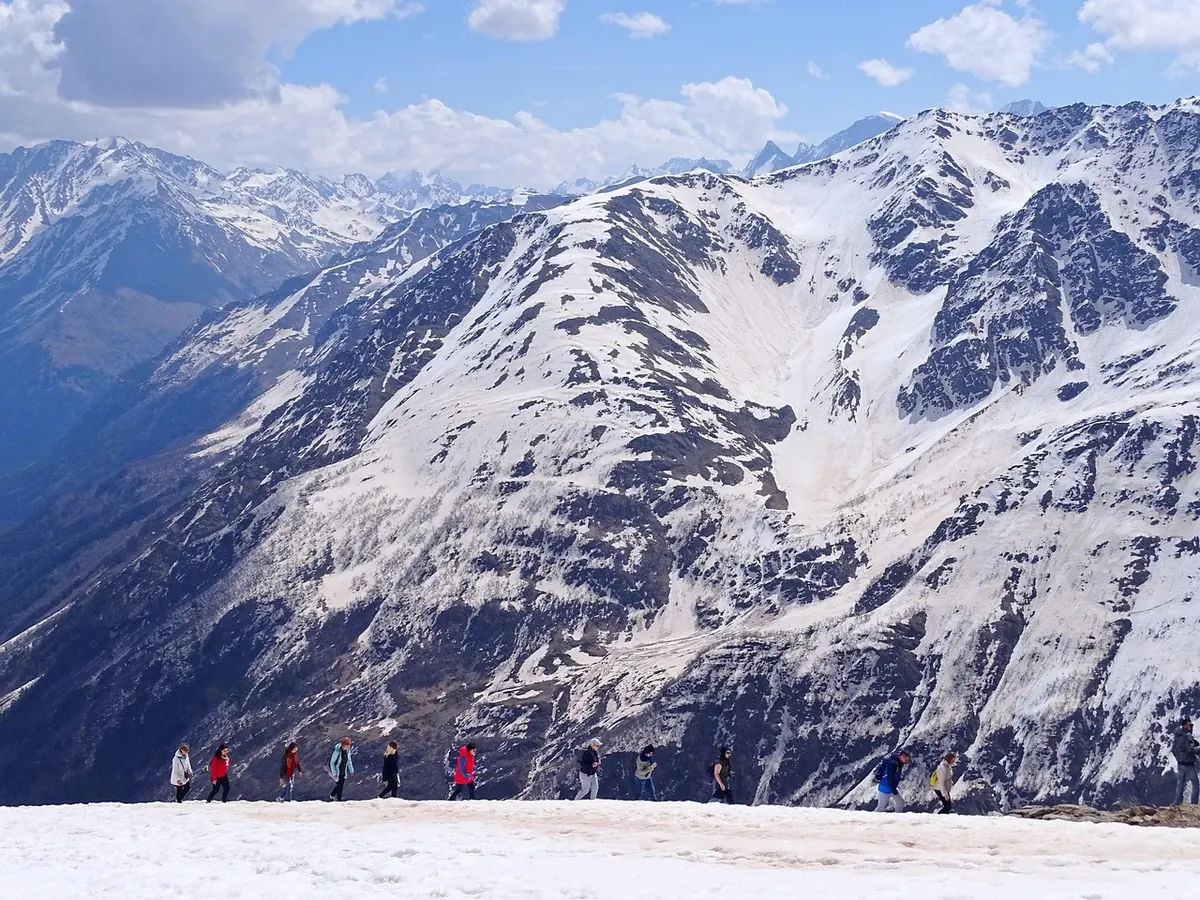
Most winter rescue calls don't start with a fall. They start with something that feels trivial at the time: a second coffee, a slow drive, a summit pushed "just a bit" further because the group is already halfway. Winter takes those small decisions and multiplies them. Daylight is short, the air is cold, the ground is slow, and everything that goes slightly wrong has less room to correct itself.
None of the seven mistakes below are exotic. They're the ordinary ones, made by fit people with good jackets and reasonable intentions. Fixing them costs almost nothing and takes less time than tying your boots. It also happens to be the difference between a day you'll talk about for years and a phone call nobody wants to make.
1. Starting Late and Hoping the Day Stretches
A nine o'clock start in July is generous. A nine o'clock start in January is a gamble you don't need to take. Daylight in the mountains in winter may look like eight or nine hours on paper, but the usable light at the elevation you're heading for is shorter than that, and the last hour before dark is exactly when tired legs stumble and route-finding gets sloppy.
The fix is simple arithmetic, done the night before. Take the route's distance and ascent from a guidebook or map, then add what winter charges on top: deep snow, trail-breaking, hardpack that needs traction, a junction buried under drifts. A six-hour summer round trip on a snowy trail is not six hours. It might be nine. Subtract that honest number — plus an hour for the unexpected and an hour for the drive in and out — from sunset, and you have your alarm time.
If the result means leaving at five in the morning, decide that the night before and put the coffee maker on a timer. Morning-you will argue. Morning-you is not to be trusted with the plan.
2. Making the Summit the Goal Instead of the Hour
Almost every experienced winter hiker will tell you the same thing in different words: the mountain doesn't care whether you reach the top, but the darkness does care when you start descending. The summit is a place. The turnaround is a time. One of those you can control.
Set the turnaround at breakfast, when you're warm, unhurried and honest. Not at the ridge, when you're invested, tired and 200 vertical metres from the top.
Work out when you need to be back at the car with at least an hour of daylight to spare, then count backwards through your descent time. That's the moment you stop, whether or not the top is close. If it isn't, the mountain will still be there in February.
Making a turnaround you'll actually keep
- Write the time down — on your phone, on a strip of tape on your pole — instead of agreeing on it vaguely.
- Set an alarm. A vibrating watch is quieter than an argument.
- Agree with your partner before you start that whoever calls the turnaround gets no pushback. No debate, no "five more minutes".
- Turn around at the call, not at the next viewpoint, the next cairn, or the next flat spot.
3. Dressing for the Thermometer and Ignoring the Wind
Minus ten in still air and minus ten with a strong wind coming over a col are two different climates. Wind chill doesn't lower the air temperature, but it strips heat from your body far faster, and exposed skin pays first — cheeks, nose, wrists, the gap between glove and sleeve.
So read the wind forecast for the elevation you'll actually be at, not the village where you parked. The valley can be calm and pleasant while the ridge above is a different planet.
The practical fixes are unglamorous. Carry a windproof shell you can pull on before you stop, not after you're cold. Cover your face and neck when the wind picks up. Put your insulating jacket on at the break, while you're still warm enough to be comfortable doing it. Add layers early — the whole game in winter is staying ahead of the cold rather than catching up with it.
Watch for the classic signals in yourself and your partner: uncontrolled shivering, fumbling fingers, mumbled speech, unusual clumsiness or confusion. Those are not signs to push on. Get out of the wind, add insulation, feed and hydrate, and descend. If someone is seriously confused or stops shivering, treat it as an emergency and get help.
4. Planning the Day With Summer Distances
Winter halves your speed more often than people expect. Postholing through unconsolidated snow is exhausting in a way that flat distance doesn't convey. Trails vanish under drifts, blazes get buried, and a summer creek crossing may be a snow bridge — or open water.
Plan by time, not by kilometres on a signpost. Carry a map and compass, and a charged phone with offline maps as backup, not as the only plan. If you're using a GPS track from a summer trip, expect to deviate, and give yourself permission to turn around at a junction that doesn't match what your map shows. Standing still and confused is not a good use of short daylight.
5. A Pack Built for a Sunny Walk
A daypack that's fine in June is thin in January. The point of a winter pack isn't to be heavy — it's to be complete enough that a twisted ankle or a stalled partner doesn't turn into an overnight. This is the short version of what belongs in it:
- Headlamp with fresh batteries and a spare set. Your phone is not a headlamp, especially in the cold.
- An extra insulating layer — a synthetic or down jacket that stays dry in the pack all day.
- Shelter: an emergency bivvy bag or a light tarp, plus the knowledge to use it.
- More food than you'll eat, including something you can eat without taking off your gloves.
- Water plus a way to stop it freezing — an insulated sleeve, a flask, or a bottle carried upside down.
- Navigation: map, compass, and a charged phone kept warm inside a jacket pocket.
- Small first aid and repair kit, lighter or matches, whistle, knife, a few metres of cord.
- Goggles, sunscreen and lip balm — snow doubles the light hitting your face.
- In avalanche terrain: transceiver, probe and shovel, and the training to use them. Carrying them without practice is decoration.
6. Not Eating, Drinking or Checking In
Cold suppresses thirst, and it's easy to finish a six-hour day on half a bottle and a cereal bar. The result is the same as always: energy fades, decision-making frays, and you get cold more easily. Eat before you're hungry and drink at every stop, even when it means pulling out a flask when you'd rather keep moving.
The other half of this mistake is silence. Someone at home should know your route, your car, your intended return time, and what to do if you're not back. That last part is the one people skip. Agree on the plan clearly: if there's no message by a set hour, they call for help rather than waiting another three hours and hoping.
Five Minutes at the Trailhead
Before you lock the car, run through this. Say the turnaround time out loud and set an alarm. Check the wind on the ridge, not just the temperature outside the window. Confirm the headlamp works and the spare batteries are in the pack. Put the map where you can reach it without taking off your pack. Send a message with your route and return time. Then start walking — early, unhurried, and with a plan that ends in a car park rather than a helicopter.
The best winter days look almost boring from the outside: out early, back in daylight, warm, fed, and arguing about dinner instead of about whose turn it is to hold the light.
Photo: Natalia_Kollegova / Pixabay
Related posts
More stories you’ll love reading