
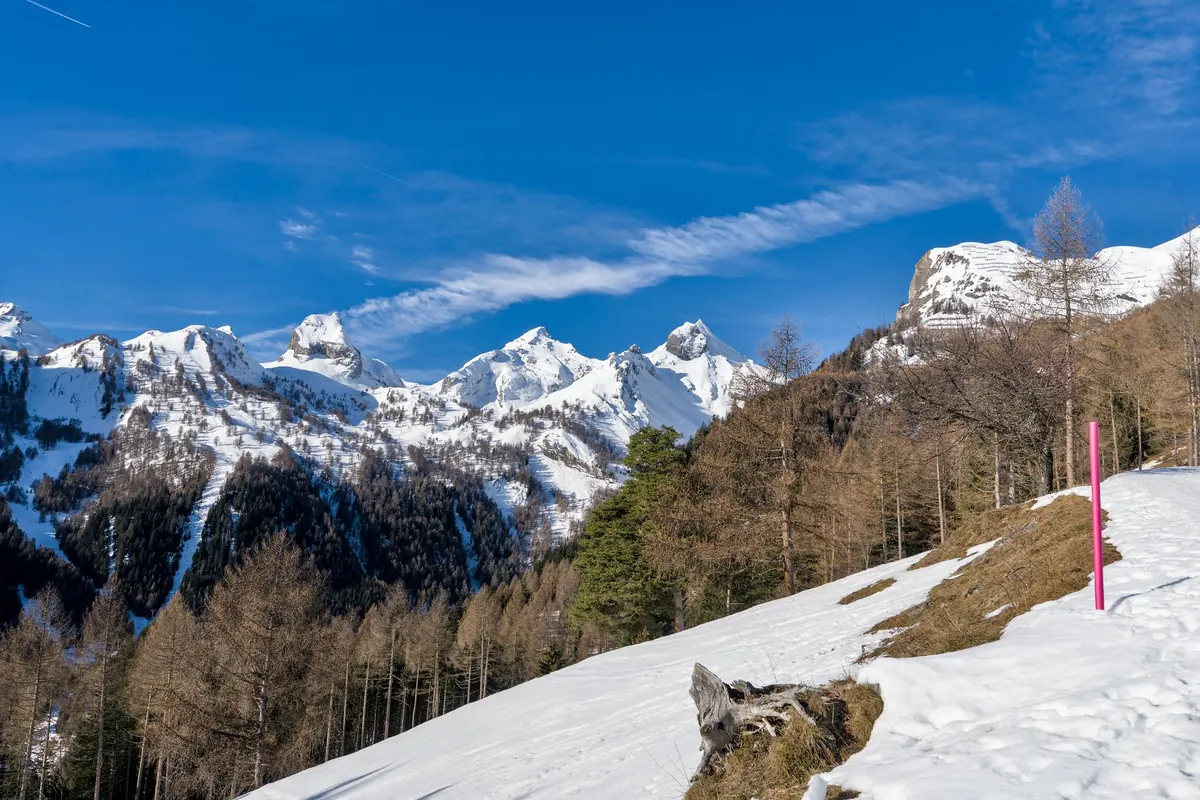
The forecast said clear skies. At 5:40 in the morning the sky was the colour of wet concrete, and the wind was moving something up on the ridge that I couldn't quite see. I stood in a small car park in the western Italian Alps with my boots stiff with cold and my headlamp pointed at the gravel, watching my guide pour the last of his coffee into a snowbank and study the slope above us with the patient attention of someone reading a page he had read many times before.
We were supposed to cross a pass that day. Up through larch woods, over a broad shoulder, across a white basin, then down the far side into a valley where a bus was, in theory, waiting. The word "theory" was doing a lot of work in that sentence. By the end of the day it would be doing more.
The Plan, and the First Time It Changed
The route looked simple on paper: roughly nine hundred metres of ascent, five to six hours, nothing technical. I had spent two weeks thinking about it as a single block of effort. My guide had spent the previous evening on the phone. He called the keeper of a hut below the pass, then a friend who farms at the bottom of the far valley, then listened to a recorded snow bulletin twice while stirring something on the stove.
In the morning he told me we were not taking the line I had imagined. Instead of climbing the open slope on the left of the valley — the obvious one, the one that looked like a staircase — we would stay in the trees on the right and gain the shoulder from behind. It would add maybe forty minutes. When I asked why, he pointed at the ridge and said only: "The wind has been from the north-west for two days. Look at the plumes."
I looked. Thin feathers of snow were streaming off the crest, blowing sideways and dissolving. I had seen the same thing from a car window a hundred times and read it as scenery. He read it as a message about where snow had been picked up and where it had been dropped.
Reading the Small Signs
What I learned on that climb is that a local guide is not a walking encyclopaedia. He is a person who has made the same journey in many different conditions and has developed a habit of noticing. Some of it was technical. Much of it was not.
Wind
Every time we stopped, he turned his face into the wind for a moment, then looked at the slope above us to see which side of it was loading. North-facing bowls held colder, looser snow. The ridges were being stripped bare and the snow was being stacked onto the lee sides. That single observation shaped almost every choice we made that day.
Surface
He also watched his feet, which sounds trivial until you try it for an hour. Refrozen crust rings hollow and carries you. Wind-packed snow squeaks. Deep, dry snow swallows the sound of your steps entirely, and that is often the snow that moves. Twice he stopped mid-stride, crouched, and pressed a gloved hand into the surface, then dug a small pit with the back of his axe to feel the layers underneath. He never made a speech about it. He just looked, then walked on or changed direction.
Sound
Halfway up the shoulder we heard a low, muffled whump — a collapse somewhere under the snowpack, a few dozen metres away. Nobody panicked. But we moved off that slope in a wide, quiet line and did not stop again until we were in the trees on the far side.
What a Guide Actually Watches
Over the day I started keeping a mental list of the things he checked, and it turned out to be shorter and more practical than I expected:
- The forecast, and its trend. Not just today's numbers but whether the situation was improving or getting worse overnight.
- Wind direction against slope direction. The combination matters far more than either one alone.
- Recent loading on lee aspects. Where the snow has been deposited in the last forty-eight hours.
- The cloud ceiling. Whether we could still see the ridge, and what we would do when we could not.
- The clock and the exit. How much daylight we had left, and which descent lines were still available if the upper mountain closed in.
- How the group was moving. Pace, warmth, whether anyone had stopped talking. Silence is information.
None of that requires an extraordinary memory. It requires being willing to look at the same landscape every twenty minutes and accept that the answer may have changed.
The Crossing
Above the trees the weather did what alpine weather does. We climbed for forty minutes in flat grey light, then the cloud lifted and the whole basin opened up in hard sunlight, and I could see the col properly for the first time — a small notch between two rounded summits with a cornice curled over its left edge like a wave about to break.
Twenty minutes later the sun was gone again and it was snowing. Not heavily. Enough that the ridge disappeared, and the world shrank to the ten metres in front of us and the line of the guide's tracks. He did not speed up or slow down. He set a bearing before the cloud arrived and followed it, checking the altimeter on his watch now and then, stopping every so often to look back and confirm the line behind us was still readable.
At the col he said one thing I have repeated to people ever since: "We make the decision before we are tired."
He meant that we had agreed at the trailhead what would make us turn around — visibility below a certain point, more than a hand's width of new snow on the lee slope, any collapsing sound above the basin. When the cloud came in, we were not deciding anything. We were just checking the list we had already written.
The Decision That Mattered
We did reach the col. What we did not do was descend the far side as planned. Standing in the notch, he looked at the bowl below us for a long time. The snow there was smooth and rounded in a way that made my stomach tighten, and the wind was visibly moving loose surface snow across it in thin, steady streams. He took out the map, folded it to the far valley, and pointed to a longer line down the eastern flank instead — a route that added an hour and a half and made the bus a lost cause.
I was, briefly, annoyed. Then we got down into the trees and the cloud closed behind us and I understood what he had been looking at. We walked out in the dark with headlamps, tired and hungry, and I would not change a single choice. The alternative descent would probably have been fine. Probably is a word I have learned to dislike in the mountains.
If You Want to Cross a Pass in Winter
Hiring a local guide is not a substitute for preparation, but it does replace guesswork with judgement. A few things worth doing before you go:
- Ask what experience and certification your guide holds, and whether they have crossed that specific pass in winter recently.
- Agree on the turn-around points before you start walking, while you are warm, rested and honest.
- Carry the avalanche kit your guide asks for — transceiver, probe, shovel — and know how to use it, not just how to carry it.
- Check the local avalanche bulletin yourself each morning and ask your guide to explain what it means for the route.
- Pack for wind and wet snow, not for the forecast you hoped for: spare gloves, warm hat, shell, headlamp, and food you can eat with gloves on.
- Tell someone at home your route and expected return time, and message them when plans change.
- Start early. Most of the day's problems are cheaper to solve in the morning.
And when your guide changes the plan, ask why, listen to the answer, and then let them lead. That is what you paid for. The pass will still be there next winter, and so, if you make good decisions, will you.
Photo: StockSnap / Pixabay
Related posts
More stories you’ll love reading